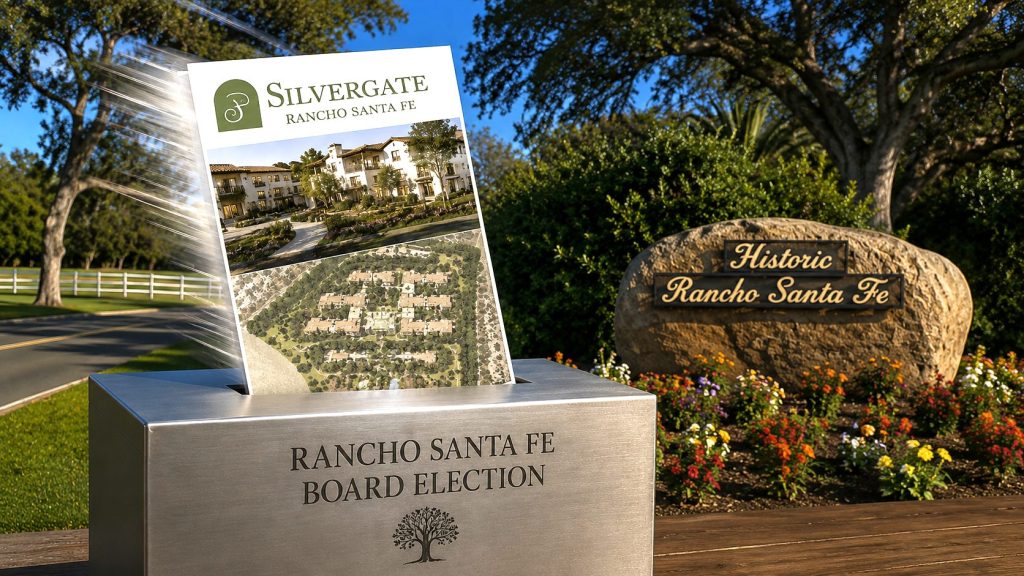
As Rancho Santa Fe’s Board election approaches, Covenant residents are asking the question: when did major development applicants start attempting to influence the very elections tied to the approval process governing their projects?
The Silvergate senior living proposal has already deeply divided the community because of its scale, density, and proposed alteration of historically low-density Covenant land at one of the most sensitive gateways to the Village. But now the project has drifted beyond a land-use debate and into the realm of HOA politics.
Silvergate CEO David Petree has publicly endorsed Board candidates Chuck Reynolds and Jeff Simmons while Silvergate’s controversial project remains under active review within the Rancho Santa Fe Association process. Similar endorsement efforts occurred during last year’s Board election cycle as well.
When Campaigning and HOA Resources Collide
Whether they are Association members or not, developers have the same right as other individuals to endorse and support HOA candidates at their own expense. What Davis–Stirling prohibits is the use of Association resources to influence the outcome of an HOA election.
That issue became controversial during last year’s RSFA Board election after then-President Courtney LeBeau sent Association-generated emails – including to members who had opted out of email communications – along with a printed “President’s Letter” highlighting the accomplishments of LeBeau and the sitting Board, to all RSFA members despite such communications historically being distributed electronically. Critics argued the mailing functioned less as a routine President’s update and more as an Association-funded campaign mailer benefiting an incumbent candidate during an active election cycle – potentially raising concerns under Davis–Stirling restrictions regarding the use of HOA resources for campaign activity.
So while Petree’s endorsement effort does not violate Davis–Stirling directly, many residents believe it crosses an important ethical line. Rancho Santa Fe is a volunteer-governed Covenant community built on public trust, neighbor participation, and independent review. When a developer with a major financial interest before the Association begins publicly signaling preferred Board candidates, it inevitably raises concerns about whether the process itself is remaining independent.
Where the Candidates Stand on Silvergate
The Silvergate project has become especially contentious because supporters frame it as inevitable – arguing that California housing laws and Sacramento political trends will eventually force Rancho Santa Fe toward higher-density housing regardless. Candidate Chuck Reynolds has reportedly echoed a version of this argument: approve a negotiated local project now, or risk something worse later.
But that argument overstates the immediate legal reality. When California housing laws such as SB 35, AB 2011, and SB 423 are examined in the context of Rancho Santa Fe’s unique conditions – including its rural estate character, wildfire constraints, low-density zoning, and Protective Covenant framework – their applicability becomes far less certain. These laws are strongest in urban, transit-oriented, infill environments. Rancho Santa Fe is none of those things.
The “approve this now or the state will force affordable housing later” narrative is less of an imminent legal inevitability and more as a negotiation tactic designed to pressure the community into accepting a project that otherwise might not gain support on its own merits.
Meanwhile, incumbent director Jeff Simmons has remained restrained on the project, likely recognizing the importance of avoiding prejudgment while the application moves through the review process. Candidate Annie Finch has taken a different approach, highlighting the need for community town halls especially after residents complained their requests to the Board to publicly discuss the matter were ignored.
Notably, Simmons himself later publicly distanced his campaign from the Silvergate endorsement effort after it was circulated. In a recent Letter to the Editor titled Keep Ranch Politics Civil and Fact-Based, Simmons expressed concern about the increasingly divisive tone surrounding the election and development debate.
What Kind of Ranch Will This Be?
And perhaps that is the larger issue now facing the Ranch. Not simply whether developers are legally permitted to endorse candidates – but whether Rancho Santa Fe residents are comfortable allowing active development applicants to insert themselves into HOA elections while their own projects are still under review.
Because once developers begin publicly backing preferred candidates, residents inevitably begin questioning whether elected directors will continue serving the community first – or the applicants who helped support their campaigns. The issue is no longer simply who gets elected to the Board, but whether Rancho Santa Fe will continue to uphold the century-old land-use protections and historic planning principles that shaped the Covenant, or gradually shift toward development-driven rules better suited for projects the original planners never intended.