There’s a biblical saying: “… be sure your sin will find you out.” Eventually.
Give it enough time, enough scrutiny and enough loose lips, and even cold-case crimes have a way of solving themselves. Politicians get caught. Cover-ups unravel. And eventually, the sibling confesses to throwing the patio table into the bonfire after running out of firewood at a high school party. (Family lore for another time.)
Silvergate reminds me of that.
So how did the largest proposed development in Rancho Santa Fe’s history get to the point where approval now seems almost inevitable?
I can tell you how it got here from my vantage point. The “why” is harder. Motives belong to the people who made the decisions. But after watching this unfold for years, patterns begin to emerge. And patterns have a funny way of telling their own story.
A Board Distracted
To understand Silvergate, you first have to understand what was happening inside the Association.
During the COVID years, while members continued paying assessments and the Association remained financially stable after receiving a $2 million line of credit, several directors pursued a Paycheck Protection Program (PPP) loan by submitting paperwork that incorrectly represented the Association’s tax status. When the mistake surfaced months later, the Association had an opportunity to simply acknowledge the error, return the money under the federal government’s “safe harbor” provision and move on. It didn’t take it.
In early 2023 when the U.S. Department of Justice came calling, the new Board, led by Courtney Lebeau, hired white-collar criminal defense attorneys and quietly negotiated with the DOJ while keeping members in the dark until after a settlement had already been reached. When it was over, the Board congratulated itself that the outcome cost members roughly $2 million instead of the potential $8 million penalty – and no one was sent to the pokey. Here’s the account from a former RSFA Director.
Looking back, I don’t think the PPP loan matters because of the money.
I think it matters because of what it revealed.
The mistake wasn’t what got the Association into trouble. Refusing to acknowledge it did. That pattern – protecting earlier decisions rather than correcting them – is one I would watch repeat itself over the next several years.
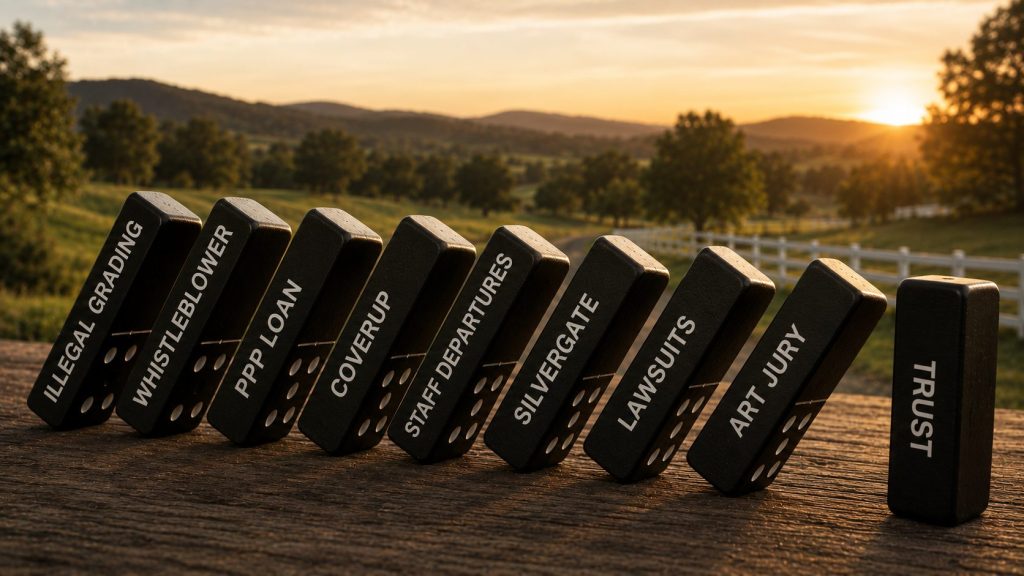
While the Association was busy playing litigation whack-a-mole – the illegal grading, the PPP investigation, a Board whistleblower complaint and a quiet wave of staff departures – another issue was steadily moving through the pipeline.
AmeriCare presented a dramatically larger proposal for the Mabee property on Calzada del Bosque and Via de la Valle. Earlier, smaller concepts had struggled to gain support. This version introduced second-story apartment buildings at a scale Rancho Santa Fe had never seen before.
At the same time, the applicant repeatedly warned that Sacramento’s new housing laws could eventually allow something even larger. The message was difficult to miss: work with us now or risk something worse later.
Looking back, Silvergate didn’t arrive during a period of strong governance. It arrived when the Association was distracted by investigations, lawsuits and internal turmoil. That mattered because projects of this magnitude require leaders willing to ask difficult questions – even if the answers are inconvenient.
The Decision That Changed Everything
Before the Art Jury ever reviewed a single architectural drawing, one of the most consequential decisions had already been made.
The Silvergate property carries dual zoning designations under the Protective Covenant. Yet someone determined the project would be reviewed exclusively under Residential Class C. The Commercial Class L designation – which had governed the property’s long-standing horsekeeping use alongside neighboring equestrian facilities – was effectively removed from the discussion.
Members immediately questioned that interpretation. Requests for advisory votes and town hall meetings were repeatedly denied. Rather than publicly debating the appropriateness of the large commercial project, the Board, led by LeBeau, relied on the Association’s attorney to explain why member petitions were supposedly invalid because they were unclear or improperly worded.
As a member of the Art Jury, I spent months reading the Protective Covenant, reviewing original deeds and tracing the property’s history. The more I learned, the less convinced I became that the Class L designation could simply disappear. I made a formal motion requesting that the Association retain an independent land-use attorney to answer one straightforward question: Could these dual-zoned parcels have one of them lawfully be ignored?
The Association hired Sheppard Mullin. The Art Jury was assured we would receive the firm’s legal analysis.
We never did.
The Board refused the Art Jury access to the legal consultants, citing attorney-client privilege. Instead, members and the Art Jury received an unsigned memorandum – not on law firm letterhead, attributed to no attorney – that summarized conclusions without answering the central land-use question.
When the Process Changed
Before deliberations even began, Board members met privately with Art Jurors and instructed them that zoning was no longer open for discussion – not because the land-use question had been answered, but because the Board had decided it would no longer be asked.
To me, that marked the moment I realized the review process was terribly flawed.
Rather than determining whether Silvergate fit the zoning, the zoning was made to fit Silvergate. At that point, the assignment no longer seemed to be deciding whether the project belonged on this site. It became making the project look as good as possible within a decision that had already been made.
As the review continued, anyone questioning the project increasingly risked being labeled “biased.” Apparently, someone had found a new favorite word and wasn’t about to let it go to waste.
Bias isn’t reaching an opinion after months of studying evidence.
Bias is reaching one before you’ve considered it.
Which is why one moment has stayed with me ever since.
During an early site visit to Silvergate’s Rancho Bernardo facility – before the Art Jury had reviewed a single architectural drawing – I watched a juror appointed by then President LeBeau – turn to another juror and say, “We just need to approve this already.”
The project had barely begun.
That same juror later participated in every consequential Silvergate vote despite missing nearly half of the Art Jury meetings. She resigned before completing her term after the project’s approval was largely assured.
That’s the thing about the truth. It has a way of surfacing when enough pieces finally come together. Looking back, moments that once seemed unrelated begin fitting together like pieces of a puzzle.
The Next Decision
Every Board president leaves fingerprints on Rancho Santa Fe, but perhaps nowhere more permanently than through the Art Jury appointments they make. Those jurors influence every significant remodel, every commercial project and every major development long after Board members have left office. That’s why their responsibility is not to applicants, staff or Board directors. It is to the Protective Covenant.
Next Thursday, the newly seated Board will choose its president.
That vote cannot undo the decisions that brought the Association to this moment. But it will determine who appoints future Art Jurors, how future controversies are handled, and what kind of leadership guides the next chapter of Rancho Santa Fe. I hope they choose wisely.
As for the patio table…the truth finally came out years later.
It usually does.
That’s the thing about the truth. It has a remarkably long memory.
So does the Ranch.
Kelli Hillard is a former Art Jury member and editor of the RSF Post.
Well written and a great read. Makes you think about how much power a board president yields.
Ranchohome,
Thank you for your engagement. Yes. Elections – on every level – have consequences. A representative government of all the people is, and has always been, the plan.