By the time Tuesday’s Art Jury meeting adjourned, the Silvergate project had once again been continued. But after hours of presentations, architectural renderings, public testimony and deliberation, the Art Jury may have come face-to-face with a reality previous meetings could not ignore: the community’s objections are not fading with each design revision.
Ultimately, no amount of architectural refinement can answer the broader question many residents continue to ask: Is Silvergate compatible with the planned community the Protective Covenant was designed to protect?
For many residents, Silvergate isn’t just about Silvergate. They worry it will become the project every future developer points to when asking for something bigger, gradually changing the Ranch’s rural character – and potentially its property values as well.
Two Different Meetings
For much of the morning, Association staff walked the Art Jury through dozens of pages of revised plans.
There were discussions about berms, tree placement, lighting levels, roof colors, materials and architectural detailing.
Then the public stepped to the microphone.
The conversation changed completely.
One resident asked:
“Who gave the Art Jury and staff the right to facilitate a developer’s project?”
Another challenged why the Art Jury had spent nearly an hour discussing landscaping and screening:
“You just today spent 45 minutes… trying to shield a project whose density is not approved by the community.”
Others questioned whether a project of this size could ever be considered compatible with the surrounding neighborhood, regardless of how well it is designed.
It quickly became apparent that the applicant and much of the community were attending two very different meetings.
One side was discussing architecture. The other was still debating whether the project belonged there in the first place.
Four New Jurors. Three Years of History.
Four of the five current Art Jury members are new to this project, yet they have departed from the directives of the previous Art Juries who repeatedly asked the applicant to reduce the project’s visual impact. Those earlier jurors concluded time and again that the proposal needed to become smaller if it was going to fit its surroundings.
In fact, in 2025, the Art Jury came within a hair’s breadth of denying the project altogether after the applicant introduced a second story to the memory care building rather than making the requested changes to reduce the overall scope. They gave a lengthy written directive: reduce the project’s size and density until it became more compatible with the surrounding neighborhood of single-family horse properties.
Yet at the March 2026 meeting, the current Art Jury president made an unexpected proposal that the developer might want to reconsider adding back the second story on the Memory Care building along with 20 additional units. That suggestion directly reversed two years of effort by prior Art Juries and community member input to reduce this project’s bulk, and mass.
For many residents, that was an astonishing comment. The previous Art Jury spent years asking how the project could become smaller. The current Art Jury is now being asked how to make it look better.
Annexation Vote Off the Table
One of the most significant changes to Silvergate had little to do with architecture.
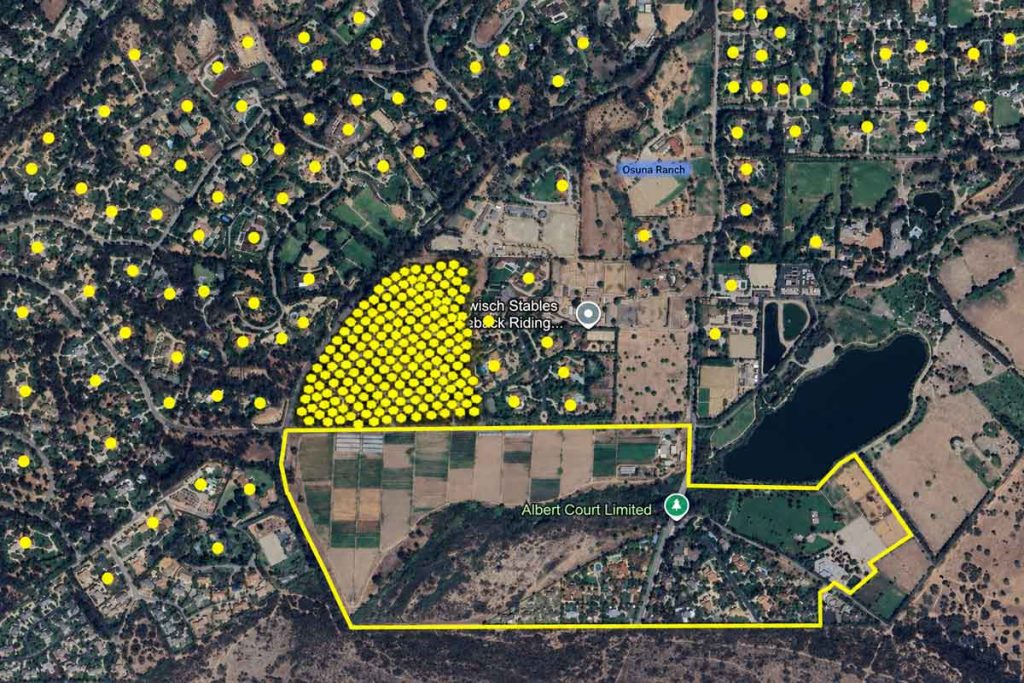
The original proposed development spanned across four parcels. Two of those parcels lay outside the Covenant and would have required annexation before they could become part of the project.
As one resident reminded the Art Jury:
“The Petrees and the Board committed to us that we would have a vote as soon as they had to annex the properties. And then they knew that the vote would fail so they took the annexation off the table. So in this whole process, there is never an opportunity for us to vote.”
Instead of spreading the development across four parcels, the applicant removed the two non-Covenant parcels and concentrated the project onto the two remaining Covenant parcels. Compressing the project onto fewer acres didn’t eliminate the concerns over bulk and mass. For many residents, it intensified them.
Another resident described it as:
“A smaller, more dense project of only two of the four lots…”
More Than Paint Colors
During the meeting, one speaker suggested that zoning is solely “a concern of the Board” and that the Art Jury’s role is simply design and architectural finishes.
However, the Protective Covenant states that both the Board and the Art Jury have authority interpreting and applying its land-use framework. In fact, the California Court of Appeal addressed this issue in a well-documented ruling when it said, “the Covenant charges the Association and the Art Jury with power to interpret and enforce its provisions.” Rancho Santa Fe Association v. Dolan-King.
A Community That Isn’t Moving On
Perhaps the most revealing moment came at the end of the meeting. Despite receiving extensive new lighting and landscape plans, several jurors said they needed additional time before offering substantive comments. After hours spent refining details, the discussion appeared to arrive back at the same place many residents had been all along: lighting and landscaping may improve a project, but they cannot answer whether a project of this size belongs in the Covenant.
Better lighting doesn’t reduce the density.
More landscaping doesn’t make the buildings smaller.
And another architectural detail doesn’t answer the question residents keep asking: Does this project belong here?
The Art Jury’s latest meeting underscored one point: no amount of landscaping or architectural refinement can answer the central question of whether a project of Silvergate’s scale and density belongs in Rancho Santa Fe.
Residents have seen years of requested reductions, the annexation vote disappear, and the focus shift from compatibility to design details. Yet the fundamental question remains unanswered.
Perhaps it is time for the Board to ask the community directly through an advisory vote and let that input guide the future of Rancho Santa Fe.
Pasquale Kourie Yorath is executive director of Protect Rancho Santa Fe, a grassroots organization of Covenant members and San Dieguito River Valley residents dedicated to preserving the region’s low-density, rural character.