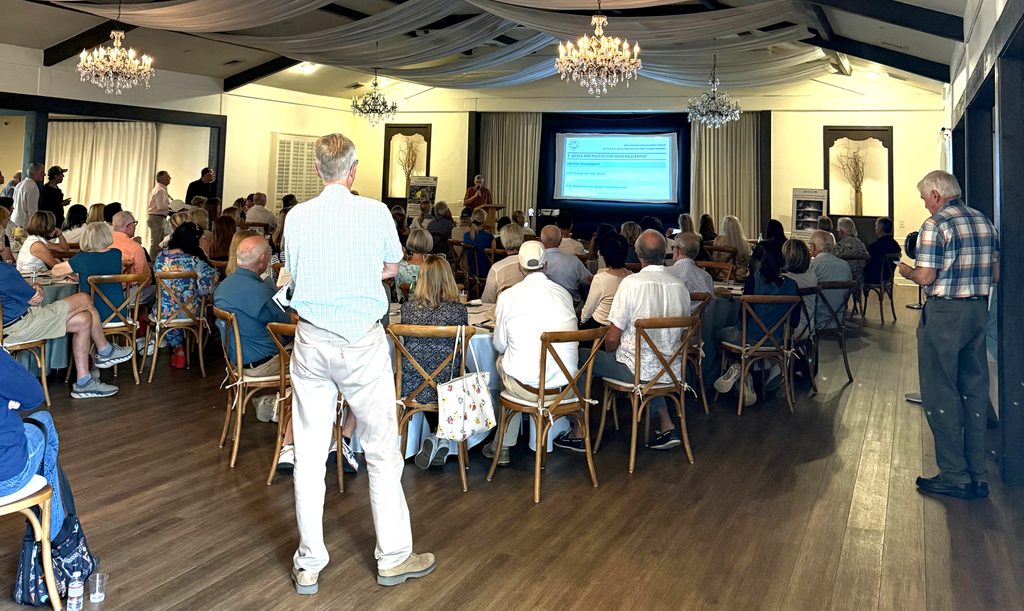
Last Thursday, Protect Rancho Santa Fe welcomed area residents to the Secret Garden in the Village for an informal Town Hall with members of Protect Rancho Santa Fe and their guest speaker Dag Bunnemeyer, a former San Diego County Planning & Development Services zoning chief.
For those who couldn’t join us, here are some of the evening’s key takeaways:
- A Major Use Permit is required. Silvergate is not a by-right residential development. The project must obtain a Major Use Permit and go through a separate, discretionary County review, including whether the proposed use, scale and impacts are appropriate for the site and surrounding community. Currently, the County designates the land as Rural Residential with a 2.86 acre minimum for single family dwellings.
- RSFA Should Wait for Environmental Review. The County’s California Environmental Quality Act. (CEQA) review remains underway, and additional environmental analysis – including an Environmental Impact Report (EIR) if required – could still be ahead. Bunnemeyer advised that the Association should take no formal position on the project until that process is complete. Roads, traffic, water, sewer, drainage, fire protection and other services must be evaluated to determine whether existing infrastructure can accommodate a development of this magnitude.
- Paragraph 1 Restricts Institutional Use. Differing legal opinions maintain that Paragraph 1 of the Protective Covenant, which prohibits institutional uses within the Covenant, is enforceable. The Fair Housing Act protects people in protected classes from discrimination when renting or purchasing housing; it does not dictate land use or require approval of an institutional use otherwise prohibited by the Covenant.
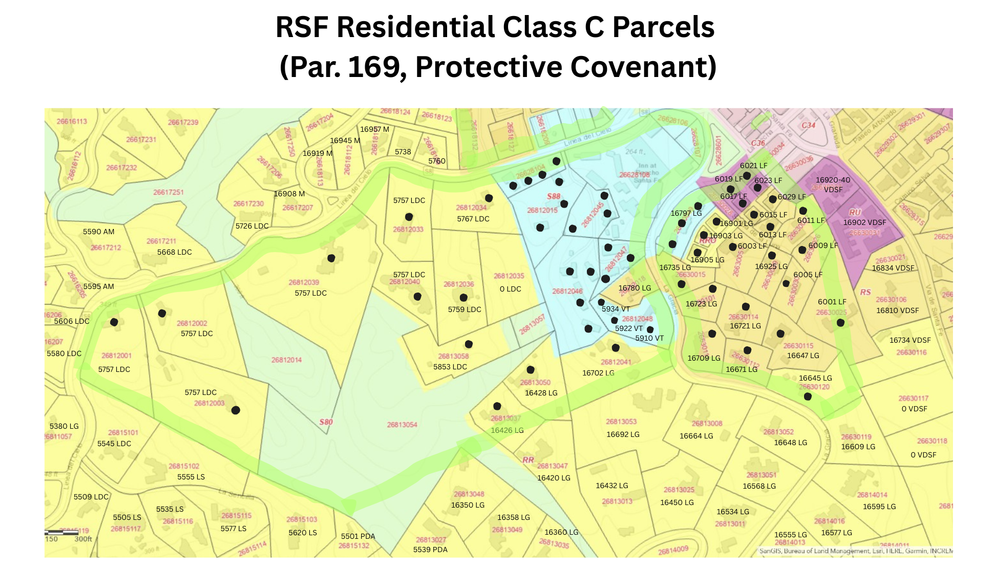
- Block M is not included in Class C District. A map presented at the Town Hall showed the standalone Class C parcels established as part of the Covenant’s original maps, and are still in effect today. Block M (Silvergate’s parcels) was not among them; it was separately restricted by both Class C and Class L. Treating Block M as Class C alone could set a precedent for future developers seeking similar higher-density development on the actual Class C parcels on La Gracia and Linea Del Cielo.
- Required variances should be addressed now. Fifty-two proposed apartments fall below the 1,750-square-foot minimum required by the RSFA Regulatory Code. Bunnemeyer said the required variance or redesign should be addressed now.
Perhaps the biggest takeaway was a simple one: residents want, and still have a voice. The evening gave residents a place not only to ask questions, but to share concerns that have grown over nearly three years. One member questioned whether the Board is truly neutral toward the project, as it maintains, while others questioned whether the Covenant’s governing documents are being followed. Understanding the rules and participating in the process matter. But so does knowing that those entrusted with making decisions are listening.
Protect Rancho Santa Fe is a 501(c)(4) nonprofit organization of Covenant members and San Dieguito River Valley property owners dedicated to preserving the region’s low-density, rural character. Donations to support the organization’s educational and community outreach efforts may be made through its website.
Pascale Kourie Yorath is executive director of Protect Rancho Santa Fe.